Katie shifted her euploidy rate to 66% at 40
After multiple failed PGT-A cycles, she layered PICSI and metformin, and created two euploid embryos.
Names have been changed to protect privacy.
When Katie had her son in 2021, it was a natural conception at 36. But like so many of us, whether trying for our first or a later child, the path that followed wasn't a straight line to a little sibling for her son.
A natural start, then loss
At 38, she was pregnant again, naturally. A miscarriage followed. Then another. And with them came a diagnosis: Antiphospholipid Antibody Syndrome. It meant every next step would need more. More monitoring, more medication, more heart in mouth.
IVF began in 2023. A standard protocol. ICSI. Mature eggs. But no blasts.
She kept going.
Cycle after cycle
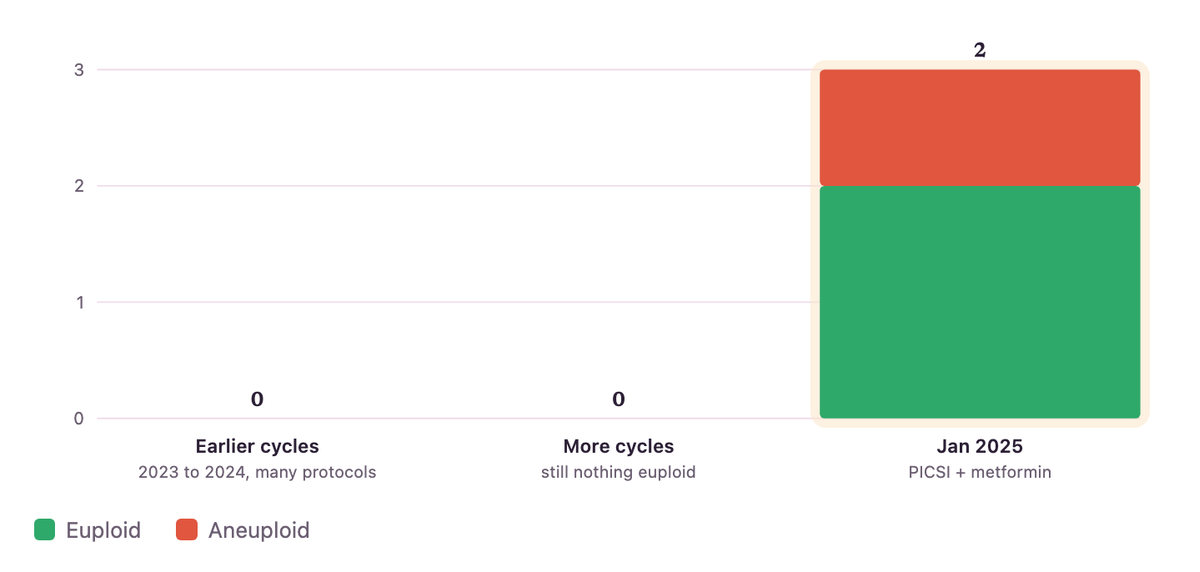
Cycle after cycle, the tweaks came. Microdose Lupron. Artificial oocyte activation (AOA). Omnitrope. Zymot. Mini IVF. And across most of the earlier cycles, PGT-A kept coming back with nothing normal, except for one early glimpse of hope in January and February 2024, which yielded a single euploid embryo. She tried the same protocol again the very next cycle, but got nothing. Just a random moment of success in a sea of aneuploid. It felt like chaos, not strategy.
Her husband, now 43, has been walking this entire path beside her. He was tested for DNA fragmentation, and results came back normal. Back then, PICSI wouldn't have been considered a clinically relevant option by their clinic, as it is typically reserved for cases with known male factor issues.
"Everything would look fine until Day 5 or 6, then it would fall apart. They weren't doing anything wrong per se, but they also weren't going above and beyond."
She brought ideas to them, things she'd read in forums or learned from other women walking the same line. They were never opposed, but they certainly weren't the ones offering any new ideas, either.
What she changed
What changed in the end? Katie found the Better IVF resources and Facebook group and took another leap into the unknown. In her final cycle, she implemented two key components she hadn't tried before:
- PICSI (Physiological ICSI), based on the HABSelect data
- Metformin (500mg daily), supported by literature for its impact on oocyte quality and embryo development
She paired those with AOA and Omnitrope, both of which she had tried in earlier cycles without immediate benefit. This time, she layered them together. And for the first time, everything changed.
She also added other add-ons which have some reasonable evidence, if not directly for euploidy then for other parts of the process: red light therapy, medical-grade HBOT at 2.2 ATA, NAD+ injections, and targeted IV drips.
The breakthrough cycle
In January 2025, at age 40, a whole year and five cycles after her first single euploid, Katie completed a cycle with PICSI and metformin layered together. She retrieved 17 eggs. 15 mature. 12 fertilised.
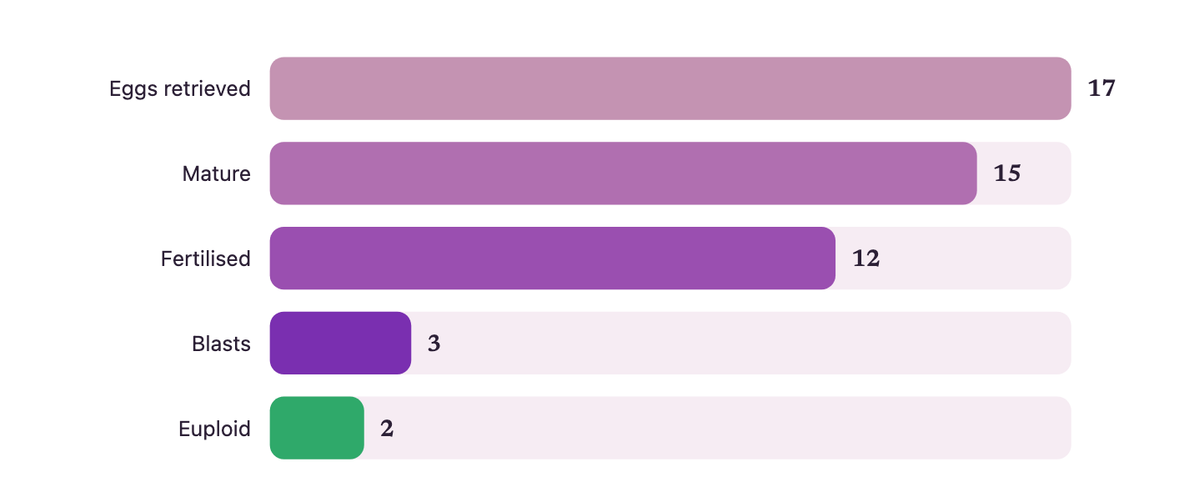
And guess what. She got two euploid embryos. That means that at 40, after multiple failed PGT-A cycles, she shifted her euploidy rate to 66%. That is equivalent to that of someone in their early thirties with peak fertility.
"I was terrified every time we changed protocol. What if it got worse? You sit with the failure of the last time for a month or two before you can even try again. That's the hardest part. But I had to know I'd done everything I could."
In her words
She's a dietician, a scientist by training, someone who tried to approach each round with both data and intuition. She admits she wishes she'd done more research upfront, but also knows that wasn't entirely fair to expect of herself.
"You can't always fight your genetics, but you can learn how to work with them."
Her story isn't wrapped up with a bow just yet, but now, she's finally holding real hope in her hands. Using two elements of the research Michelle at Better IVF armed her with to have more meaningful conversations with her medical team and determine the right solution for her, Katie has created two precious chances at life. She will be proceeding to surrogacy with these embryos as soon as possible.
And for those still in the middle of it all, Katie offers this:
"As hard as it is, stick it out. We're not close to the finish line but we're a little closer than we were. Everyone has their own threshold, but how I think about it is this: if you're gonna lose sleep over it, you're not ready to quit yet."
Because women after 38 deserve more.
You are not alone, and you have options. Wherever you are in this, there is usually a next step worth taking. Let's find yours.