PICSI: the HABSelect trial, summarised
A natural grip test for sperm before ICSI, and the 2022 reanalysis that shows why its benefit grows the older you are.
Explore the trial interactively
The same evidence as an interactive tool: move through the ages and watch how PICSI shifts live-birth and miscarriage odds, drawn straight from the HABSelect randomised trial.
See the HABSelect trial data explorer →What is PICSI / ICSI-HA
The method I wanted to share but needed to find time to sit down and try and explain in a simple and methodical way, is PICSI. What is it? PICSI (physiological ICSI), or ICSI-HA (ICSI-Hyaluronic Acid) mean the same thing. It is a method of ICSI that is done in a two step process:
- Step 1: Pop sperm in a dish along with hyaluron micro drops. The sperm stop moving when they bind to the microdrop (this is good, tells us they have lower DNA fragmentation), and from there they can be transferred to another dish for final selection based on their morphology.
- Step 2: Once best sperm are selected, the embryologist continues with the ICSI procedure as normal.
You can watch the process in action here IMPORTANT NOTES TO BE AWARE OF:
- PICSI is NOT ICSI. They are two different things. They ultimately do ICSI at the end of it, but the start of the process in how the sperm are selected is different.
- Also, this process is already used by many IVF clinics in cases of low fertilisation or sperm quality issues but I want to be clear, this study that I refer to in this article was NOT focussed on people with sperm issues or low fertilisation rates. It was a randomised controlled trial which simply looked at the difference between ICSI and PICSI on live birth rates in untested embryos.
Why is PICSI so incredibly beneficial for women over 35 years old?
We’ve heard it all before…the older you get, the worse the quality of your eggs. Blah blah blah. We’ve had it drilled into us so many times we can’t even imagine a world in which sperm selection could actually be the KEY to making a marked difference in our embryo euploidy rates.
Here’s what that looks like visually:
See, your bastocysts may still be graded nicely as you age. That bit doesn’t change too much. They still look pretty, but inside…it’s a war zone. Look at how euploidy starts dropping off a cliff starting at 35 and continuing to decline until we enter peri-menopause. And this trend dramatically decreases the chance of live birth from any embryo you transfer the older you get.
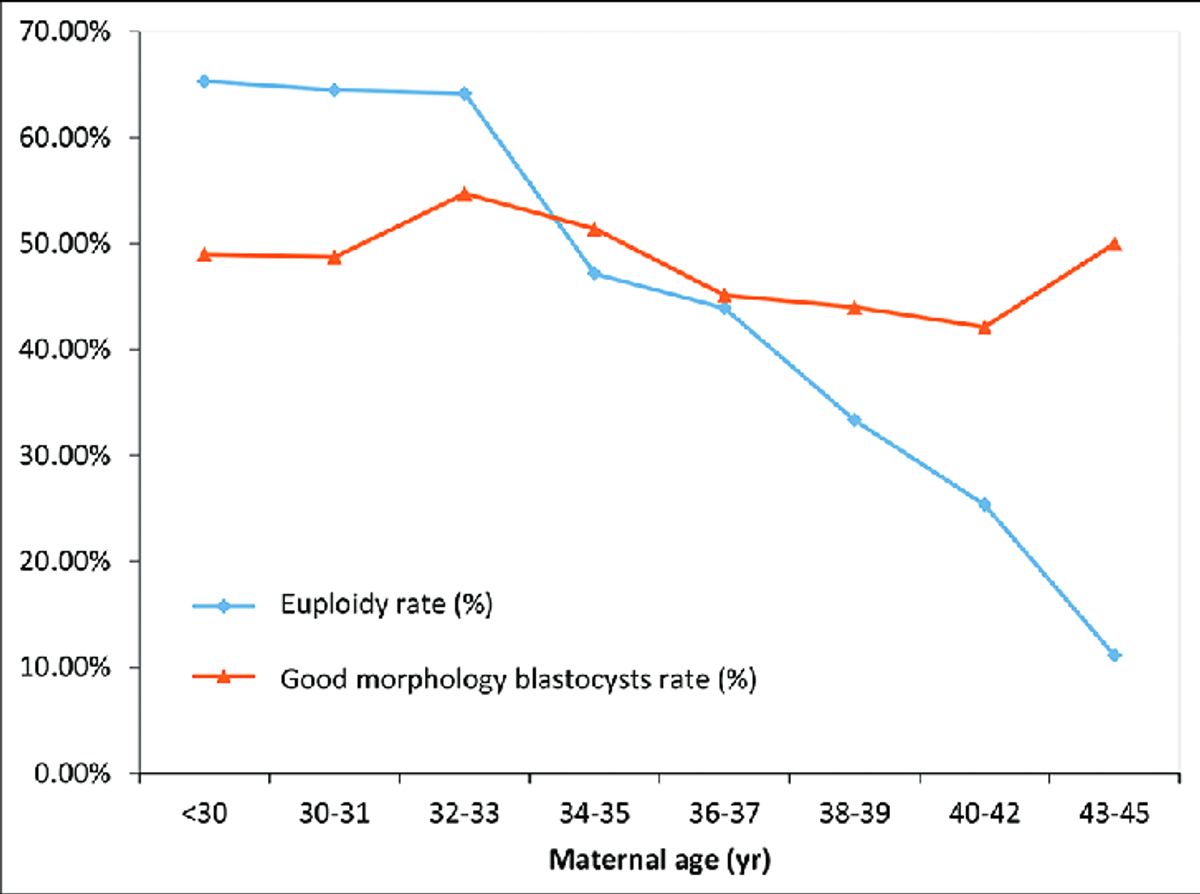
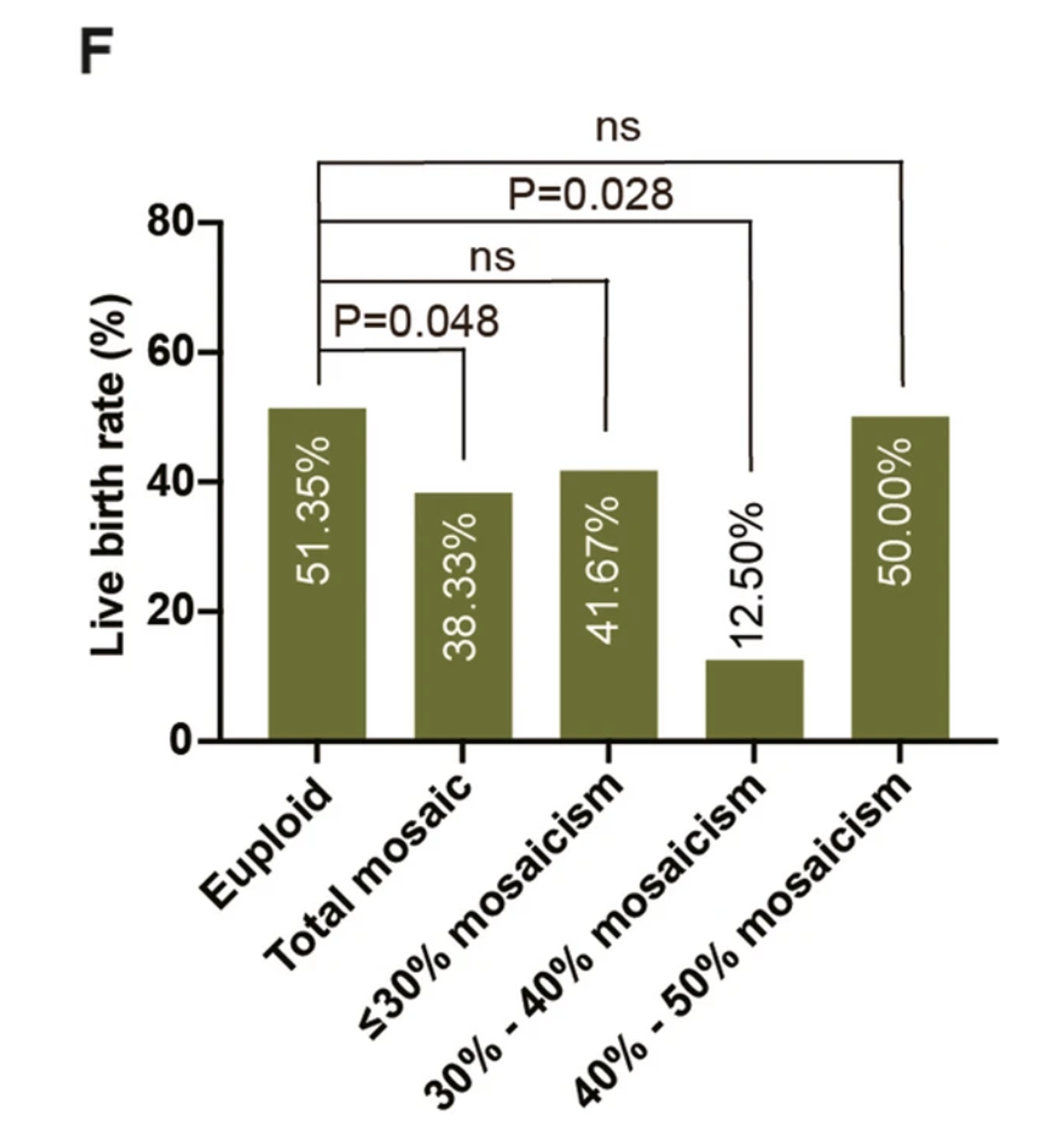
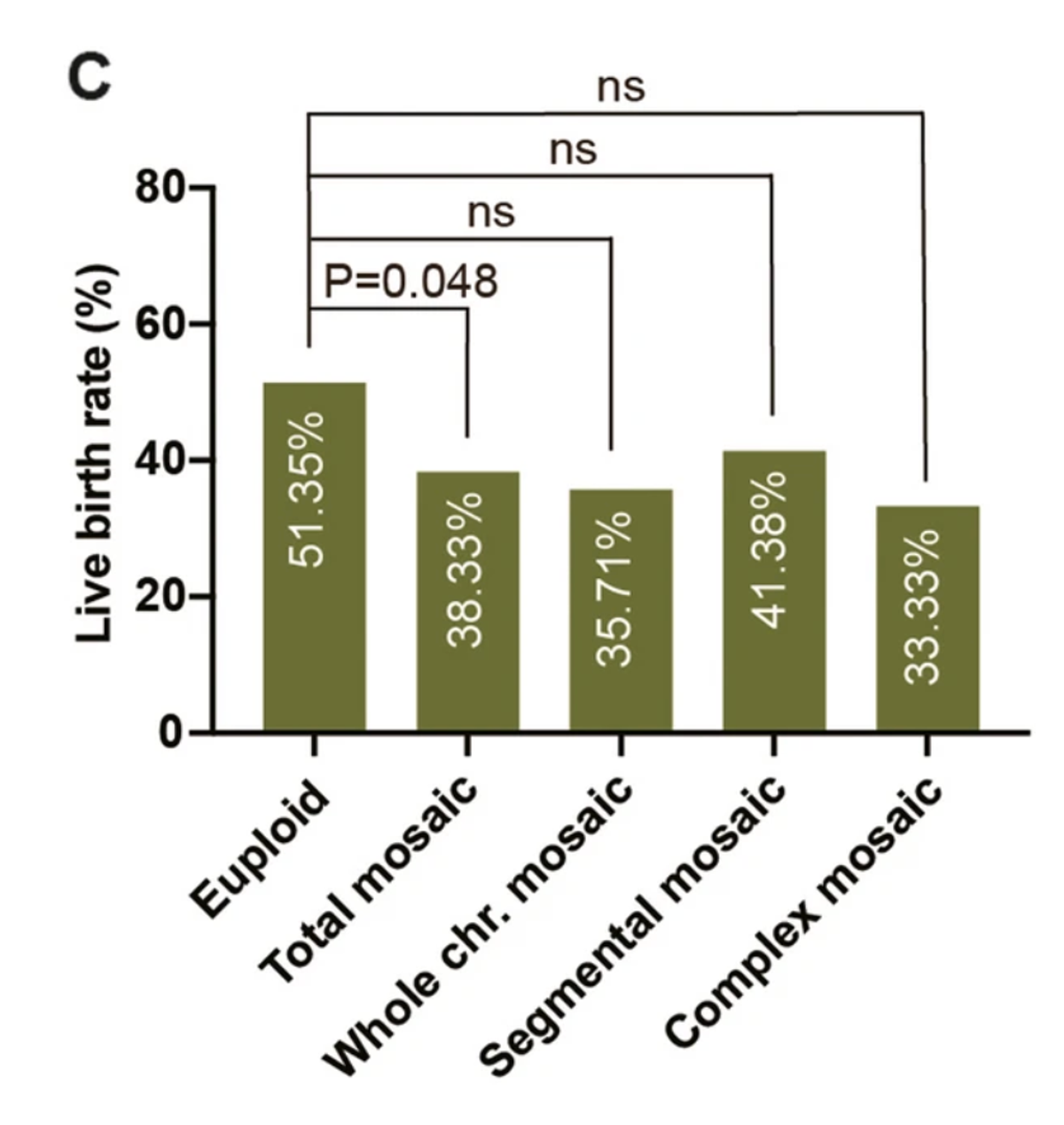
Why is that though? Because the chance of and number of chromosomal errors in your embryos increase and that, in turn, means that the euploidy and mosaicism rate drops dramatically.
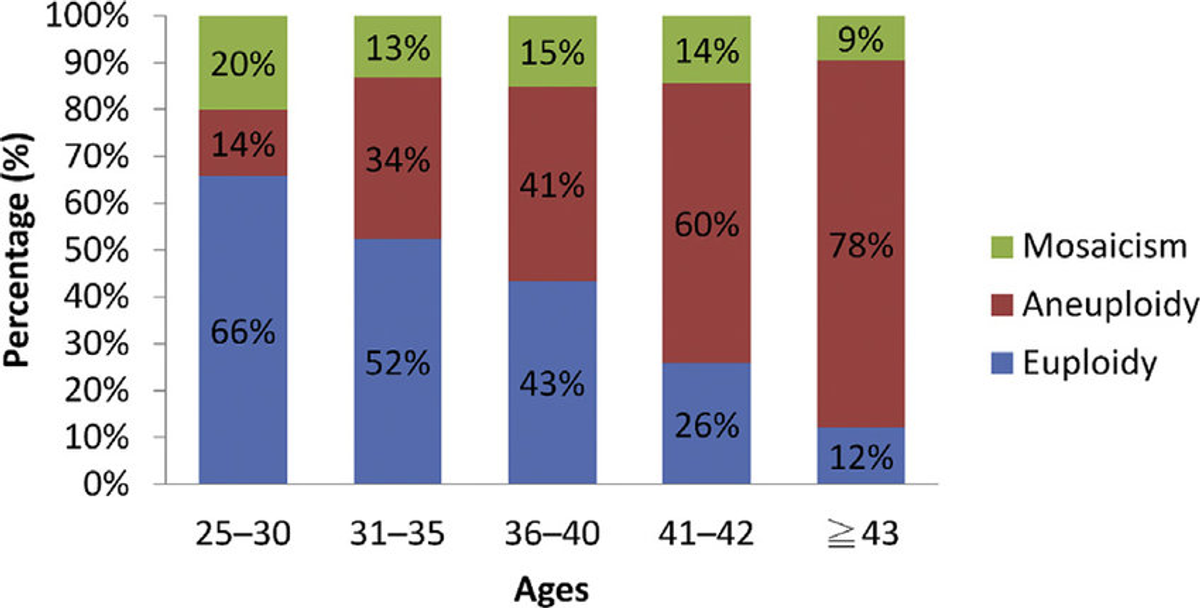
Another way to put it is this: your chance of a live birth with an aneuploid embryo (of which, by 41 years old, 60% of your embryos will be), is a measly 1.6%. You can read my mini meta analysis on that separately here.). So the odds really do get worse. Although both mosaic and euploid, if you can get them, carry a good chance.
And let’s say you DIDN’T do PGT-A testing, so that means you didn’t actually know which embryos were euploid or mosaic, you just transferred them and they happened to stick—what would that look like on the flip side?
Well, it’d look like this graph: A massive, massive increase in miscarriage rates. Because aneuploid embryos can still implant at quite a high rate. Often up to 20%. It’s just that only 1.6% of them end in a live birth…which is exceptionally low odds. (By the way I’m not talking about survivable aneuploidies here like Trisomy 21—Down Syndrome—or XXX / XXY, which most clinics tend to refuse to transfer.)
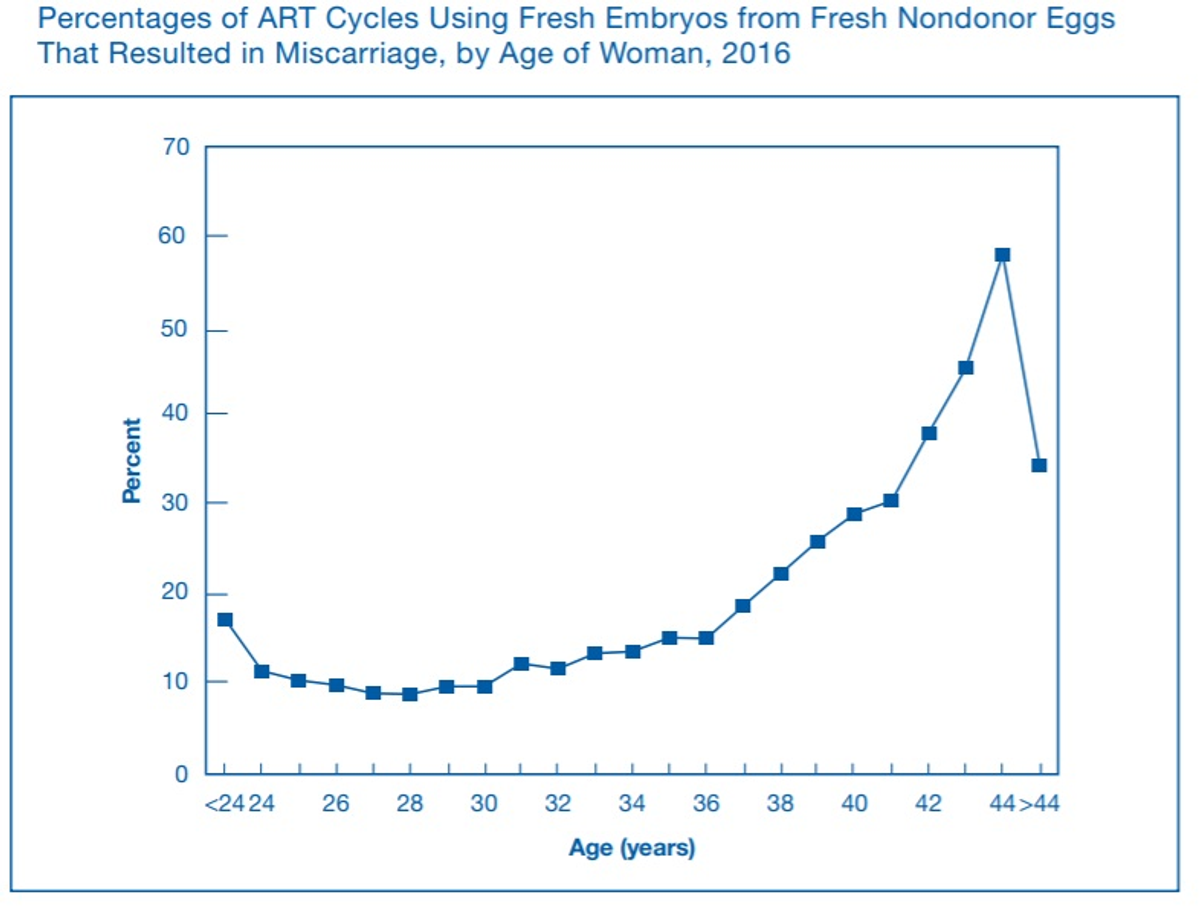
How do we know that the miscarriage is caused by a chromosomal error that leads to aneuploidy? Because basically if you can get a euploid embryo that is of good quality, check this shit out…voila! Age doesn’t mean shit now:
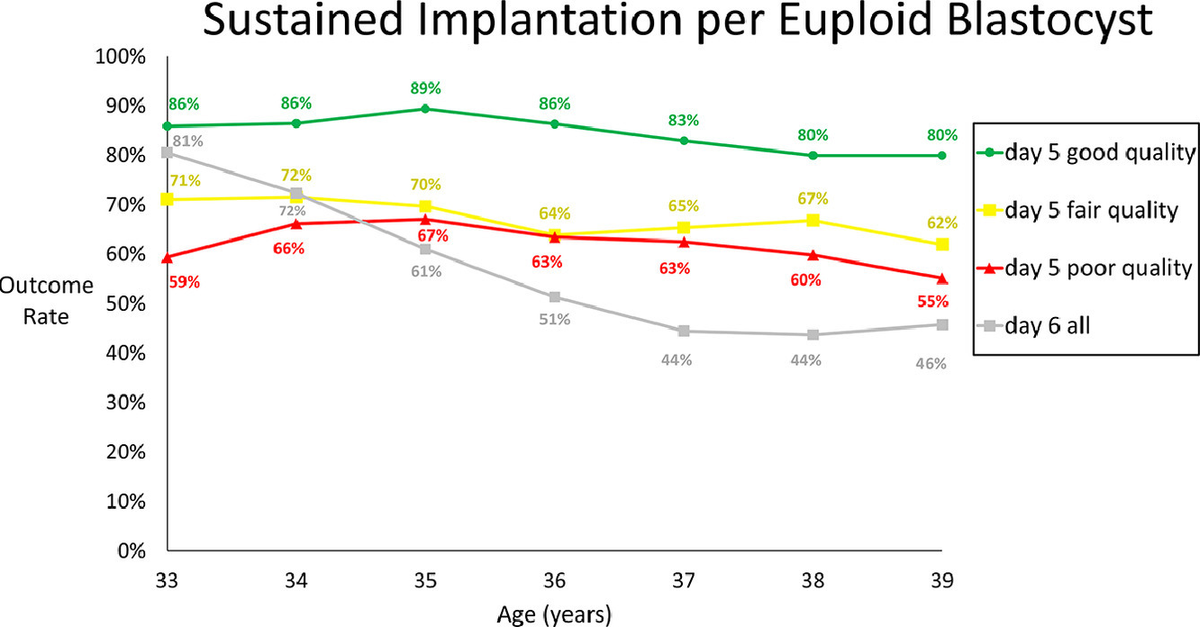
That all sounds well and good but the compounding problem is that:
- Not only do women experience a big drop in the chance that the embryos we DO produce are euploid or mosaic ALSO…
- The total number of blastocysts a woman is capable of producing drops too!! See the graph below:
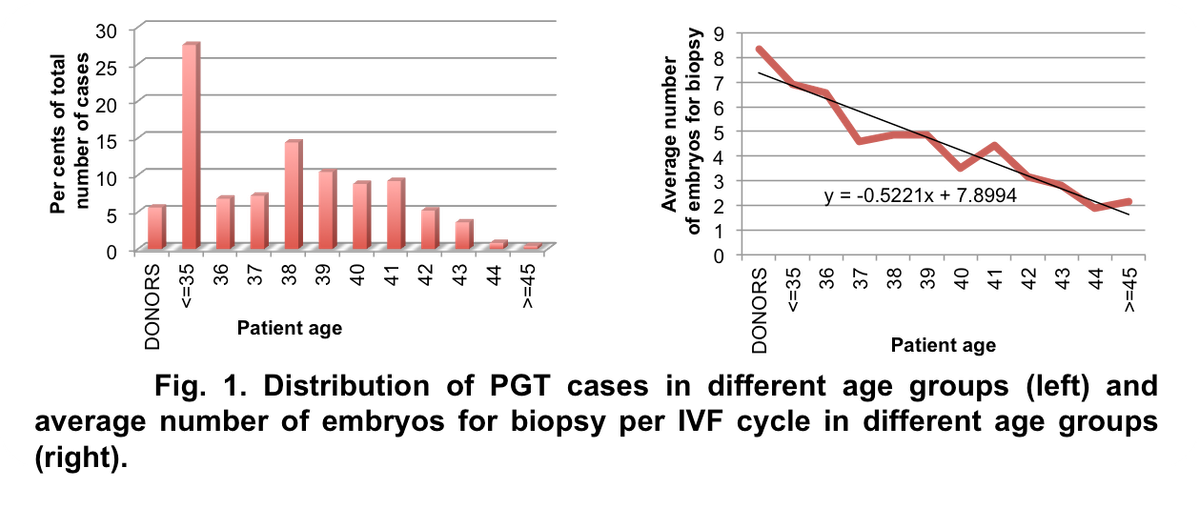
And you can see in this other table how that plays out from the point of oocyte retrieval all the way through to blastocyst. Basically it starts with women having less follicles retrieved, less oocytes mature and less MII oocytes fertilised over time so potential blastocysts are lost at each one of those conversion points.
| Age (years) | Oocytes retrieved | Mature oocytes | Fertilized oocytes | Cryopreserved blastocysts | Blastocyst conversion rate (%) |
|---|---|---|---|---|---|
| <30 (n=155) | 18 (12-24) | 14 (10-20) | 11 (8-16) | 7 (4-11) | 68.4 (53.3-87.5) |
| 30 (n=88) | 19 (11-26) | 14 (9-20) | 12 (7-16) | 7 (4-10) | 67.3 (50.0-85.2) |
| 31 (n=139) | 17 (12-22) | 13 (9-19) | 10 (7-16) | 7 (4-10) | 71.4 (57.1-83.3) |
| 32 (n=161) | 18 (12-24) | 14 (9-20) | 12 (7-16) | 7 (4-11) | 71.4 (53.9-83.3) |
| 33 (n=157) | 16 (11-22) | 12 (8-18) | 10 (6-15) | 6 (3-10) | 66.7 (50.0-83.3) |
| 34 (n=208) | 15 (11-24) | 12 (9-17) | 10 (7-14) | 6 (4-10) | 66.7 (52.9-85.7) |
| 35 (n=257) | 15 (10-19) | 11 (8-16) | 9 (6-13) | 6 (4-9) | 71.4 (52.9-85.7) |
| 36 (n=257) | 14 (10-21) | 11 (7-17) | 9 (6-13) | 5 (3-8) | 66.7 (50.0-80.0) |
| 37 (n=289) | 13 (10-19) | 10 (7-15) | 8 (5-12) | 5 (3-8) | 66.7 (50.0-83.3) |
| 38 (n=276) | 13 (9-19) | 11 (7-15) | 8 (5-12) | 5 (2-8) | 66.7 (50.0-81.8) |
| 39 (n=272) | 12 (8-17) | 9 (6-13) | 7 (5-11) | 5 (3-7) | 66.7 (50.0-83.3) |
| 40 (n=297) | 12 (8-16) | 9 (6-13) | 8 (5-11) | 5 (3-7) | 66.7 (50.0-82.6) |
| 41 (n=230) | 11 (7-16) | 8 (5-12) | 6 (4-10) | 4 (2-6) | 62.5 (50.0-80.0) |
| 42 (n=204) | 10 (7-16) | 8 (6-12) | 6 (4-9) | 3 (2-5) | 57.1 (42.9-75.0) |
| 43 (n=153) | 11 (6-15) | 9 (5-12) | 7 (4-9) | 3 (2-5) | 57.1 (42.9-75.0) |
| 44 (n=77) | 9 (6-12) | 7 (5-10) | 6 (3-8) | 2 (1-4) | 50.0 (37.5-66.7) |
| ≥45 (n=60) | 8 (4-13) | 6 (4-10) | 5 (3-7) | 2 (1-3) | 50.0 (37.5-66.7) |
| Test for linear trend | p<0.001 | p<0.001 | p<0.001 | p<0.001 | p<0.001 |
Let’s do an example here just to play it out. Let’s say you’re 41 and you manage to get 3 day five blastosysts.
From the earlier graph we know that at 41, an average of 60% of embryos will be aneuploid. Now that’s 1.8 embryos…but you can’t have a half aneuploid embryo, can you.
So that leaves you with a single embryo that is perhaps euploid or mosaic.
And what if you only make 2 blastocysts instead of 3?
Well then it would be quite “normal” for your age to expect that potentially BOTH of them are aneuploid based on those averages.
Ok so at 35, you might be producing 4-9 day 5 or day 6 embryos, but by the time you hit 44 you’re producing only 1-3. You’re running out of eggs…not a huge amount you can do about that…which means you HAVE to find a way to optimise your euploidy rate.
But HOWWWWWWW??!! Yep, that’s the million dollar question isn’t it.
Meanwhile your embryologists and doctors will happily tell you you should just accept a shitty euploidy rate as inevitable for your age.
Well…keep reading and I’ll show you why it is not inevitable.
Enter…PICSI
Ok so we already know what PICSI is, but now I’m going to share with you a study that shows what it DOES; what outcomes it can produce.
So back in 2019, results from a study called HAB-Select which was run between 2014 and 2016 and included 2,752 couples was released. And this study was really a GOLD STANDARD study: parallel, randomised, two-group double-blinded study which meant that neither the researchers nor study participants knew which group they’d been assigned to (obviously the embryologists had to know though to do the procedure!).
And drum roll….here was the result
Um, hang on what? Are you wondering whether you read that right? That doesn’t sound awesome at all. That sounds like it makes no bloody difference really, doesn’t it?
Well that’s what a lot of places thought at the time, and that was the key takeaway from the study for at least two years afterward (and is still ingrained I’d say in the vast majority of IVF clinics). Around the world medical journals continued to report , as did medical education sites, that there was no evidence of improvement in live births when comparing PICSI to ICSI, based on the outcome of the study.
In fact HFEA which is the IVF authority in the UK has marked, and continues to mark (but is in the process of reconsidering) it’s black traffic light for the use of PICSI as a treatment add on that has “no effect” in the outcome of IVF.
But note the dates of the two publications I linked to: Both before June 2022.
I’m sad…are we getting to the good part yet?
Yes my lovelies, yes we are :)
Ok, fast forward three years or so to 2022 and one of the authors of the initial study, Professor Jackson Kirkman Brown (PhD), released a NEW study called: Mechanistic analysis of sperm selection with hyaluronic acid and treatment outcomes
In this analysis, Kirkman-Brown and his team basically looked at all of the data from the original research back in 2019, and they used a statistician to help them break down all the outcomes in far more detail BY AGE COHORT. So…same study, just broken down by age.
The reason he wanted to dive deeper, was because he noticed something from their initial research report: while there wasn’t a significant live birth difference at the top level (2.2% - it would have needed to be higher than that to be statistically significant), there WAS a significant difference in the miscarriage rate. In fact, it looked like it dropped by 47.3%!
Now remember…these embryos weren’t tested for euploidy. And these were not women with significant recurrent miscarriage concerns. So when one thinks about what could possibly be the reason for that massive reduction in miscarriage rate between the two, by process of elimination, it is most likely to be embryo quality (or, in other words if it were PGTA tested…the embryos’ euploidy/mosaicism rate!)
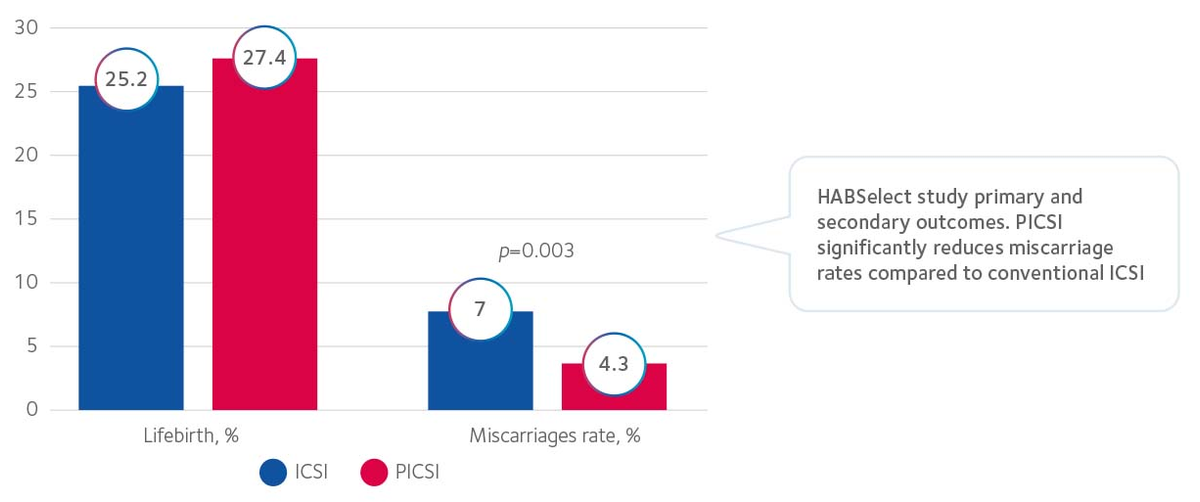
All well and good, but how does PICSI change the game for euploidy
Ok now for the REAL drumroll…so when Prof Kirkman-Brown and his team modelled out the predicted live birth rate, the graph below is what the data told them.
What. The. Actual. F**k.
You’re seeing what I’m seeing right? Well the study author sees it too. Frankly I don’t think the study really calls this out in the same stark way that Kirkman-Brown did in his presentation at a Cooper Surgical webinar which you can watch yourself here.
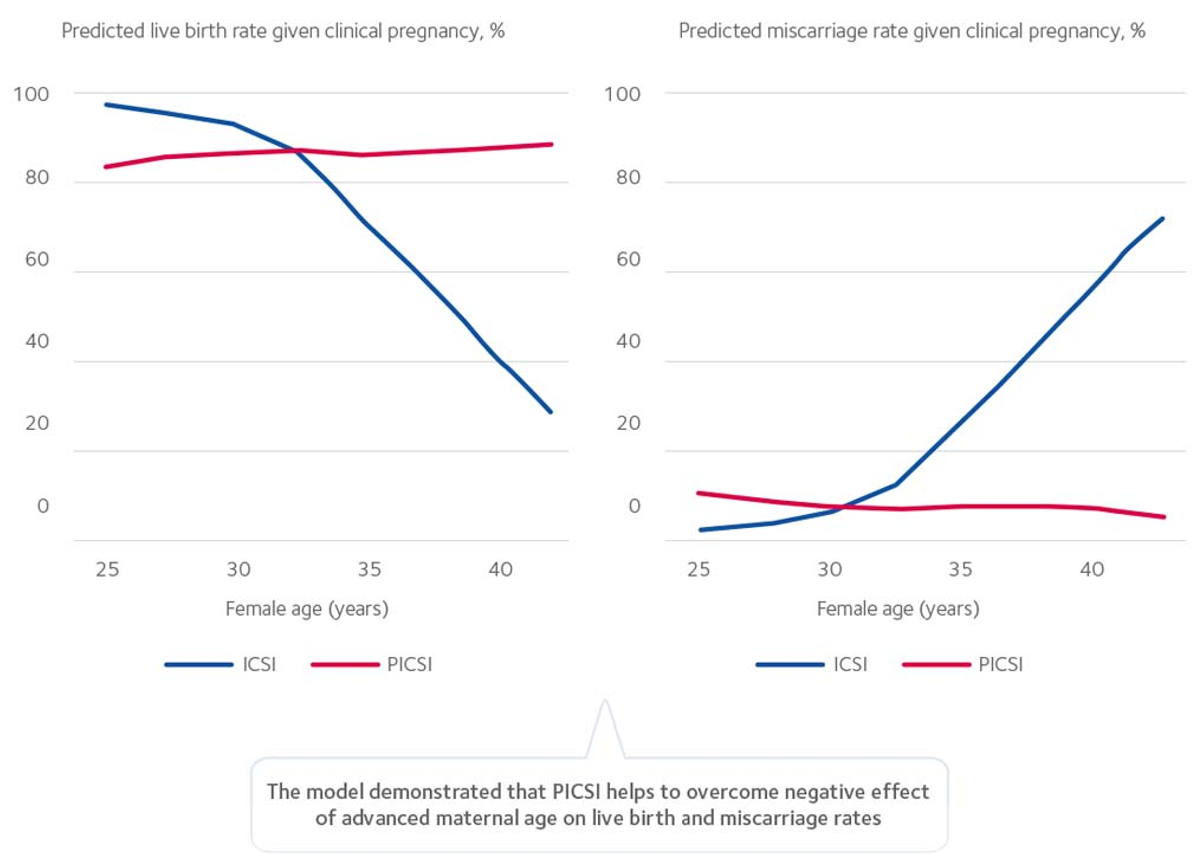
Now let’s bring back those original graphs I showed you earlier. Euploidy rate trends on the left, and miscarriage rates by age on the right (or above and below if you’re on mobile). These are general outcomes—not specific to PICSI or ICSI.
Yep…they’re basically a mirror of one another. It makes sense. Because the 2019 study did NOT use PGT-A tested embryos (tested for euploidy/aneuploidy), you’re seeing the impact of all those aneuploid embryos being transferred randomly as well (which increase as maternal age increases). And yet, once pregnant, what’s happening here is a 43 year old has the same chance of a live birth as a 33 year old.
So in simple terms, this is effectively what this new research says:
So ok, maybe your blastocyst numbers are down as you age. But if you can produce two embryos, then even to 43, PICSI gives you the best chance of ensuring that one of those embryos is euploid/mosaic. And if you can still produce 5 embryos, then 3-4 of them could be euploid/mosaic.
This means…that even a 43 year old woman with no other concerns related to the uterine environment itself, and an ability to still produce 1-2 embryos per cycle, could give herself a 99% chance of a live birth as long as she did about 5 IVF cycles, or 93-96% chance of a live birth across 3 IVF cycles.
Why those extraordinarily high numbers of a positive outcome? Because this study on cumulative live birth rates after five consecutive euploid embryo transfers from a whopping 123,987 patients and 64,572 euploid transfers, as well as this study on three successive euploid embryo transfers for 4,429 patients, told us so!
I mean…my mind is utterly and completely blown. Isn’t yours?
F**k, we’ve been spending our money on supplements, on infusions, on ovarian PRP, this and that shit here, there and everywhere…and this technique has been hiding under our noses for TWO WHOLE YEARS.
And basically this is saying that the reason for our supposed “decreasing egg quality” was likely related to the god-damn sperm all along?!! It’s hard not to laugh really, isn’t it.
And guess what, if you just go and ask your IVF clinic for PICSI right now without explaining all this to them I can GUARANTEE you they’ll say something like this: your blastocyst development is absolutely fine and your sperm has no problems and your fertilisation rate is good and that’s the only reason we’d use PICSI so you’re all good, you don’t need it.
😭😭😭😭😭
Please don’t let them tell you this. This is them just not understanding this study, not understanding or not being aware of this data yet. You need to use my template here which I’ve created to help people who have “normal” euploidy rates for their age (which…when we’re talking 40+ means LOW euploidy rates no matter what) to communicate effectively with their doctor and make sure they have a much higher chance of their doctor saying YES to this treatment add on.
Righto, but the graph wording says “predicted live birth”, is the data just a hypothetical model then, not based on real data?
Good question. NO, it’s not a hypothetical model. And yes, it is definitely based on real data. And you can hear exactly what the research author had to say in response on the webinar here.
If you want a bit more understanding on this you can open out this toggle
When the study refers to a "model," it indicates that the researchers used actual live birth data and clinical outcomes from the HABSelect trial, but they employed statistical techniques to build a predictive framework that links these outcomes to specific factors, such as sperm DNA quality (DNAq), sperm characteristics, and age. Here’s how it works:
- Actual Data: The model was built using real data from the trial, including live birth outcomes, miscarriage rates, sperm quality (measured by DNAq assays), and participant characteristics such as age and sperm motility. These factors were recorded for over 1,200 couples, providing a robust dataset.
- Statistical Analysis: To develop the model, the researchers used statistical methods like logistic regression and correlation analyses to explore how different variables (e.g., DNAq, hyaluronic acid binding score (HBS), age) were associated with clinical outcomes (live birth, miscarriage, etc.). The analysis aimed to find patterns and relationships in the data.
- Filling in Gaps: While the model used real data, in some cases, it needed to account for variability or gaps where there might have been fewer participants in certain age groups or other subcategories. To handle this, the researchers applied statistical techniques like multivariable regression to predict outcomes based on trends in the available data. This allows the model to "fill in" predictions where direct data might be sparse by relying on patterns from the larger dataset.
- Model Refinement: The model used parsimonious selection, meaning it aimed to include only the most significant variables that could explain the outcome trends while removing noise or less relevant factors. This helped ensure the model was both accurate and not overfitted to the specific dataset.
Ultimately, the model demonstrated that the interventional avoidance of sperm with poor DNA quality (via HA selection) was a significant factor in equalising live birth rates across different age groups, especially among older women.
Relationships between HBS and DNAq with embryo quality and clinical outcomes were explored indirectly by aggregating the original data into 10-year intervals for patient age and 10-point differences for measures of sperm HBS and DNAq.
The limitation however, is that it is still a retrospective analysis which means it does have limitations and that’s why a prospective study (randomised and controlled) is already in the works AND the UK IVF authority is already reconsidering its rating for PICSI off the back of this analysis, but change at that level takes time. Do you have that time to wait around for it to get the official stamp of approval some time in the next five years? I know I didn’t.
So how on earth did the original study end up showing no difference when all ages merged together?
Quite simply:
- Because over 60% of the study participants were UNDER 35 (even though this is not actually representative of IVF patient cohorts in the UK and elsewhere - it’s normally the other way around)
- AND under about 33, ICSI actually appears to do better than PICSI. This is still unclear why but that appears to be the case.
Those two things combined basically caused the overall averages to look as if there was very little difference in outcomes…when it couldn’t be further from the truth for those of us older ladies.
And we know from other studies like this one, that when we compare ICSI versus conventional IVF, that there is no difference in miscarriage rates between them. Which suggests that PICSI should be a standard procedure for EVERY woman over 35 doing IVF. And Kirkman-Brown says so himself here in his webinar.
Ok now I’m angry. Why the f**ck are we not all being offered this shit?
Excellent question my friends, excellent question. I have investigated this and come up with the following likely reasons:
- People are still looking at old studies on PICSI. Studies that did NOT look at live birth rates, and studies that did NOT break down the implications by age. Plus, it takes time for IVF clinics to change their procedures. They’re businesses after all, with many layers of management, and the people at the top aren’t always up to date with the latest in research. Also, I don’t think this secondary study has been very well “marketed” at all. (I say this as a professional marketer).
- Certainly some IVF clinics are already beginning to talk about how powerful it is…but not enough of them, and I’ve noticed mainly UK clinics (likely because that’s where this research has come from). If it were US research perhaps more places would probably know about it.
- The UK, which is where this study was done, the authority still hasn’t updated it a traffic light system for PICSI as an add on to IVF. Prof Kirkman-Brown did note in the webinar that they are reconsidering the rating but of course government bodies move SLOWLY. So we can’t wait for them, we’ll practically be in menopause before that. But this is probably another reason why IVF clinics are reticent to recommend it to all their patients. They all have ethics committees that are required to take guidance from these bodies which in some cases are responsible for accrediting them.
- Embryologists may hear just the top line stats at the conference still being presented (from the 2019 study), rather than the broken down age cohorts (from the 2022 updated analysis study). It’s a REAL shame that the original study didn’t include the cohort analysis from the beginning because by separating them it has caused incredible confusion and misinformation. I don’t know how widespread this new knowledge really is. Personally, PICSI was offered to me by an embryologist at my IVF clinic on my FIFTH cycle within 12 months…but that was only because I’d spent an hour talking to her team and I’d built up a strong relationship with them over the previous cycles. My doctor certainly never mentioned it as being helpful and that’s understandable because again, his main known usage of it is indicated by problems that I did not have.
- It’s also a logistical issue. The embryologists I spoke to said that it takes more than double the time of ICSI. So maybe 6-10 minutes instead of 3 mins per oocyte being fertilised. So you can imagine what that would mean in terms of cost and embryologist team capacity. Let’s say 14 mature eggs need fertilising, that’s 2 hrs vs 45 mins. With four egg pick ups a day of a similar outcome that’d wipe out an entire embryologist’s day when with ICSI they’d still have half a day left.
Who does PICSI ultimately benefit the most?
PICSI, for the most part benefits women who:
- Are older than 33 (and the older you are, the greater the benefit you’ll get)
- Can produce embryos (day 5 blastocysts)
- And may have at least been capable of producing a single euploid or mosaic in a previous cycle. If the woman only produces aneuploid embryos it is still possible that PICSI helps, but it won’t have the same benefit as others.
*You don’t have to have have done PGT-A testing though to get the potential benefit of PICSI.
And who does it NOT help?
Well unfortunately its not going to help:
- Folks who have cancelled cycles
- Those who get to egg pick up but produce very few eggs and struggle to get to blast. PICSI doesn’t necessarily lift the number of eggs or embryos (although there have been some studies that suggest it can improve fertilisation rates so if you have ENOUGH eggs in the first place that could be enough to create an extra embryo for you)
- While it may help some with male factor infertility, it depends on the kind. If the sperm bind but are basically immotile or very low rates of good morphology, then PICSI isn’t going to fix that any more than straight ICSI can.
- It’s not going to fix transfer problems or recurrent miscarriage related NON-EUPLOIDY issues like endometriosis or fibroids or immunological problems such as high natural killer cells.
Again, PICSI is best at simply improving the quality of the embryos that are already being produced.
Separately, I have also scrolled through all the IVF Facebook forums to find people who have used it. There are not many. The vast majority of those who have got excellent results. However I found a couple of cases of people who had, prior to the PICSI cycle, NEVER made a blastocyst, or NEVER gotten a euploid or even low level mosaic embryo and then gone ahead and tried PICSI. Those people did not get the same benefit. Unfortunately this sub cohort cannot expect the same level of increase that those who simply have a lower than average euploidy rate vs 100% aneuploidy. But I have now seen (since writing this article originally), cases where people have gone five cycles without a cycle euploid, then gotten their first two euploids after adding just PICSI.
Should you do it anyway even if you struggle to create blastocysts at all or you create blasts but none of them are euploid at all or even mosaic?
Well, it’s not hugely more expensive so even if you’ve previously struggled to create blasts or even a single euploid or mosaic, there is absolutely no harm in trying it.
What should you do now?
You should ADVOCATE for yourself. You take this article to your doctor and you tell them to read it! You say that you want PICSI and you provide them with these key research links if it helps:
- Original study
- Updated analysis with age cohorts
- Cooper Surgical webinar presentation to andrology and embryology
- How one UK ivf clinic is implementing PICSI in their lab
Then please let me know how you go with treatment and report back on any changes you have with PGT-A results. I’d love to hear! I will share mine too.
As of 2024-09-18 for my fifth cycle this year, I collected 19 eggs, 12 mature, 11 fertilised with PICSI (91% fertilisation rate), and I should have my PGT-A results in the next couple of weeks.
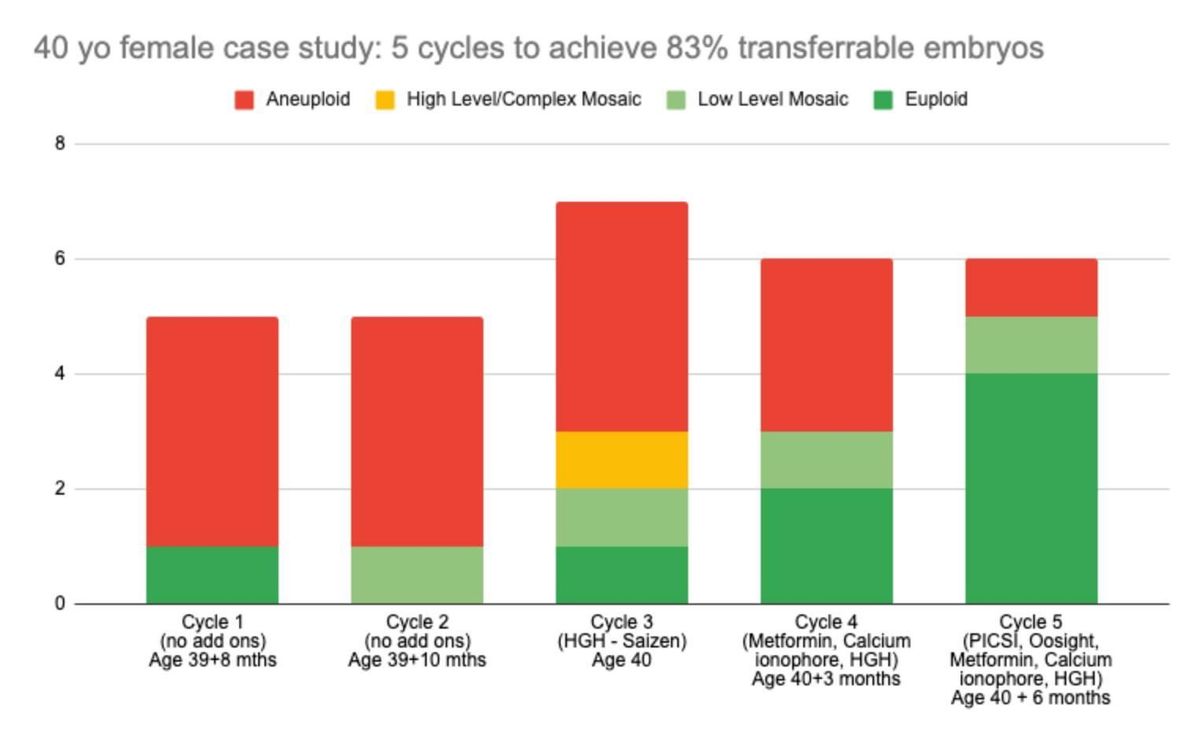
Update 2024-10-12 I received my results back after writing this article and I was able to double my euploidy rate again with PICSI. So in effect it took me from a very low end average of a 43 year old cycle— when combined with HGH, calcium ionophore and low dose metformin—to that of a 25-30 year old. 6 blastocysts, 5 day 5 and 1 day 6. 4 blasts euploid (66% euploidy) and 1 blast low level mosaic (83% transferrable). If you compare that again to this graph you’ll see that’s the exact rate of a 25-30 year old per this study of over 1,000 embryos.
These are my own cycle results over the course of five cycles. The last cycle is where PICSI was added on top of the other items. You can find more info on this here.

Written by
Michelle Bourke
Founder of Better IVF and citizen researcher. Infertility diagnosis at 36, two children via IVF (first at 37 and second at 41). Leveraged research to shift euploidy rate at age 40 from average 43 year old to average 25-30 year old.
Because women after 38 deserve more.
You are not alone, and you have options. Wherever you are in this, there is usually a next step worth taking. Let's find yours.